

What you are playing — and where the original lives
Krillion is the game to explore when your favorite part of a word prompt is finding an answer that other people might overlook. This independent guide helps you approach that challenge deliberately: understand the category first, look beyond the most familiar response, and avoid confusing an unusual idea with an irrelevant one. For immediate play on this page, try our independent Rare Dive above. To play original Krillion, use the explicitly marked external link.
Two separate games: Rare Dive uses original artwork and a limited local bank of 21 prompts, 271 answers and 101 aliases. Its 10–100 scores are editorial choices, not actual survey percentages. Original Krillion runs on an external website. It is not embedded here, and we do not provide its accounts, answer database or support service. The diagram below is our editorial illustration, not a screenshot of the original game.
What the original source actually tells us
Krillion’s official FAQ identifies its creator as kp. It describes answer sets assembled from reference sources, familiarity-based scoring with additional judgment, and gem choices that are not simply the rarest response. It also acknowledges possible missing answers and imperfect autocorrection. Those facts are a reason to keep relevance, coverage and reward separate. Source: the official Krillion FAQ, checked October 19, 2026.
Before your first round: establish the rules you are playing
Start on the original service and read the mode you have selected. Do not carry over a timer, maximum score or round count from a Noillirk page. Similar names are not evidence of identical rules. Notice whether the screen is asking for a broad category, a narrowly defined set, a particular spelling or a response from a specific time period. These details determine whether an interesting candidate actually belongs in the answer space.
Give yourself a simple pre-round routine. Make the prompt readable, check that you can see the answer field and submission control, and remove distractions that could hide an important message. On a small screen, first try the page in a comfortable orientation. If your keyboard covers a control, dismiss it to inspect the interface before submitting. These are general browser-play habits, not a claim that we have verified every device or every original-game layout.
A three-pass method for thinking beyond the obvious
1. Read the boundaries before generating answers
Identify the noun and each qualifier in the question. A prompt about a city is different from one about a capital; an animal is different from an animal commonly kept as a pet. Silently restate the condition in your own words. This takes little effort and prevents a common mistake: finding a clever word for a broader question than the one actually asked. If you cannot explain why your answer belongs, move back to a candidate you can justify.
2. Generate a small family of candidates
Think of one familiar example first, then move sideways within the same category. You might explore another region, a different material, a narrower subtype or a less celebrated member of a well-known group. Avoid switching categories simply to become obscure. Two or three defensible candidates are often more useful than a long list of half-remembered names. The aim of this exercise is disciplined recall, not finding a loophole in the wording.
3. Choose a clear expression
Prefer an unambiguous name over a description that could refer to several things. When a candidate depends on a spelling you cannot remember, weigh that uncertainty against another answer you can express confidently. Do not invent an abbreviation and expect the judge to understand it. The receiving system may handle aliases differently from your own mental category. A clear answer makes it easier to understand the result, even when the mapping turns out to be incomplete.
A worked thought exercise without giving away a puzzle
Imagine an invented prompt: “Name an animal that someone might keep as a pet.” A familiar-response approach starts with a dog or cat. A less obvious approach might explore a stick insect. The useful reasoning is not “the longer word must be better.” It is that the candidate remains an animal, there is a plausible pet context, and it moves away from the first examples many readers would recall.
Now tighten the imaginary prompt to “Name an animal commonly kept as a household pet in your area.” That additional wording changes the problem. The unusual candidate may be less appropriate because the word “commonly” matters. This exercise is deliberately hypothetical: none of these words is claimed to be accepted, rare, valuable or present in today’s original game. It demonstrates why careful reading matters more than collecting a universal list of supposedly high-scoring answers.
You can repeat the exercise with your own neutral categories, such as a musical instrument or a type of container. Write a short reason beside each candidate. If the reason relies on a strained technicality, treat that as a warning rather than a breakthrough. Practicing this way builds a reusable skill without copying a live solution, importing an answer table or pretending to know the original judge’s exact ranking.
Read the result as feedback, not as a verdict on your knowledge
After an answer is processed, separate three questions. Did your idea fit the prompt? Did the system recognize the form you submitted? How did that recognized answer score under this particular version? A disappointing reward does not automatically mean the idea was wrong. A missing mapping does not establish that the idea should earn a high reward either. Keep both possibilities open until you have evidence from the game’s own explanation.
For a useful personal review, note the prompt wording, your exact input and the visible response. Do not rewrite your input from memory into a cleaner spelling and then compare that different answer with what happened. If a correction route is available on the original service, provide a concise report rather than repeated submissions or a claim that a search result proves a numerical score. Our website cannot adjudicate another service’s mappings.
Switching from Noillirk without carrying over the wrong habit
Common-answer play asks you to favor a familiar response. Rare-answer play encourages you to explore beyond that first instinct while still respecting the question. You can enjoy both without treating them as mathematical inverses. A response that performs well in a common-answer table need not have a predictable value in a separate rare-answer system, because the tables, categories and reward choices can all differ.
Our local Noillirk preview is particularly important to distinguish: it uses artificial counts to demonstrate a proportional score and an animated crowd. It is not evidence of what Krillion players answer, and its 100-point result cannot be converted into an original-game reward. Use the side-by-side comparison for the broad choice of experience, or the Noillirk score calculator to inspect our own formula.
Browser and mobile troubleshooting before you retry
If the original page fails to load, first confirm that the address is the original destination rather than an unrelated search advertisement or copy. A connection problem is different from an answer rejection. Keep any visible message, check whether the rest of the page has loaded, and avoid rapidly submitting the same input while the outcome is uncertain. Refreshing may affect an active session; read the original service’s guidance before relying on recovery.
If text or controls are difficult to see, try the browser’s zoom controls and a different orientation. Be aware that a larger display font can change how much fits above the keyboard. Do not disable protective browser settings or install an extension merely because an unfamiliar page promises to fix the game. This guide offers general troubleshooting, not a certification that every browser combination has been tested. Persistent original-game issues belong with that service’s support options.
Make another attempt useful instead of merely longer
A good reason to return is a specific learning goal: read qualifiers more carefully, express a candidate more clearly, or broaden the examples you can recall in one category. You do not need to click through unrelated pages to unlock that practice. The original-game link remains available at the top, and the related links below are optional routes to explanations that answer different questions.
If you play alongside friends, agree whether you want a spoiler-free discussion before sharing answers. You can compare reasoning without posting a complete solution: explain the category boundary you noticed, or why you discarded an uncertain candidate. That keeps the next person’s experience meaningful. This is a suggested social activity, not a claim that the original service has a particular multiplayer feature or that our local private-room test connects to it.
Krillion questions, answered plainly
What is the playable game at the top of this page?
Rare Dive is our independent browser-local game, not original Krillion. It uses 21 original question sets, English answers and listed aliases, original Canvas artwork, and fixed editorial rarity scores from 10 to 100. Those scores are not survey percentages or live player counts. Seven rounds have a 25-second timer; submit a listed answer to reveal immediately. Empty or unlisted answers earn zero when the round ends. Daily uses the same seven prompts throughout a UTC day; Practice shuffles and prioritizes unseen questions locally. Repeats remain possible in this finite bank. Reloading restarts your active run; your best score and seen-question history can be stored on this device. There is no account sync, AI judge, public leaderboard or original-game save integration.
Where can I play the original Krillion?
Use the clearly marked external link to krillion.io near the top of this guide. It opens the original service in a new tab. This page is an independent explanation, not a mirror, a downloadable copy or an embedded original game. Check the destination before entering account information anywhere.
Is Krillion the same as Noillirk?
No. The useful contrast is rare-answer thinking versus common-answer thinking. Their implementations and answer tables are separate. Our Noillirk preview adds its own synthetic-count demonstration and does not turn into Krillion by subtracting a score from 100. Read the comparison page before comparing results.
Does an unusual answer always earn a better reward?
Do not assume so. Unusual is useful only after the answer fits the prompt and is recognized by the selected game. This guide cannot predict a reward from an example word. Review the original game’s explanation and consider category boundaries before chasing obscurity for its own sake.
Can I find today’s Krillion answers here?
No. This is a spoiler-light strategy guide, not a daily solution feed or a complete answer list. We do not have an imported original answer database. The illustrative words on this page explain a way of thinking and should not be treated as confirmed answers to a current puzzle.
What should I do when a reasonable answer is rejected?
Keep the exact prompt and your submitted spelling, then check the original service’s help and feedback options. Distinguish an answer that does not fit from one the table may not cover. Our contact address cannot change Krillion scores, approve its aliases or recover its account data.
Can I practice without copying other players’ answers?
Yes: create your own category exercise away from a live round. Write one familiar response, then two less obvious candidates, and explain why each fits. This is a learning activity, not a reproduction of the game’s scoring. Avoid consulting a shared solution list if you want your next attempt to remain your own.
Does this page save my Krillion progress?
No. This guide has no connection to an original-game account or save file. Any progress on the external service is governed by that service. Our local Noillirk session and its test scores are separate. Do not assume that a familiar game name means accounts or statistics transfer between sites.
How many questions and seconds does Krillion give you?
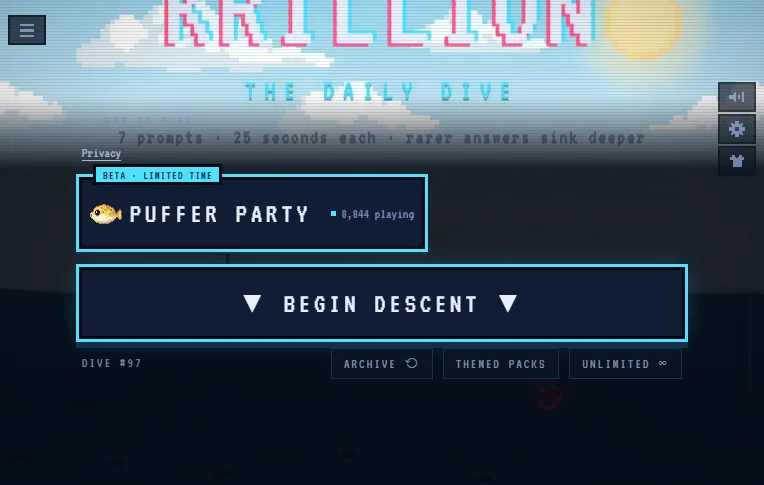
The daily start screen checked on October 21, 2026 shows seven prompts and 25 seconds per prompt. These are the daily-mode rules we observed, not a promise about every mode. Check the original start screen before you begin; do not carry over Noillirk’s 15-second timer or its scoring formula.
Choose your next step
If you are ready for the original experience, follow the external link. If you want to understand why common-answer and rare-answer strategies differ, stay with the comparison. If your interest is how a score can be explained without inventing evidence, inspect our data inventory. Each destination has a different purpose; none is a required step before you can leave this guide and play.