One good answer. Two ways to think.
A familiar question with a different objective
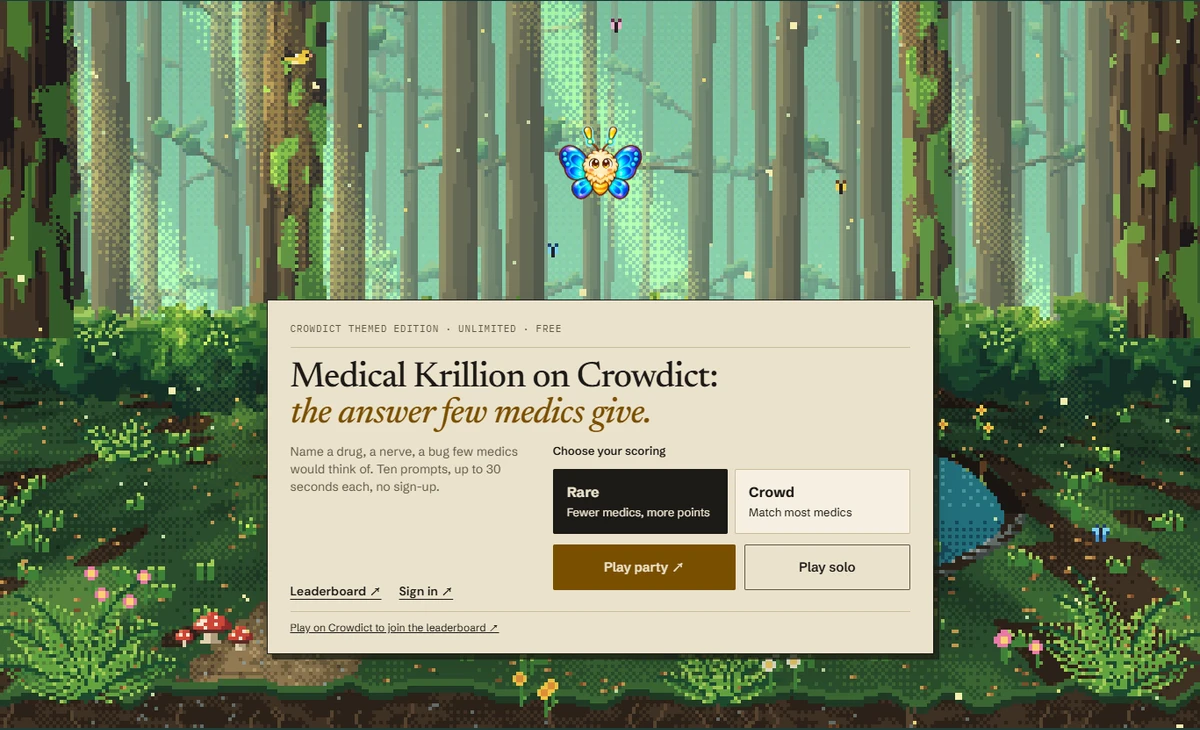
Medical Krillion begins with a simple task: read a prompt and type one answer that belongs to the requested group. The interesting decision comes after you remember a valid term. Do you want the answer that springs to most people’s minds, or a less obvious member of the same category? This page brings that decision into focus for players arriving from Noillirk’s common-answer game. You can go straight to the player above or try the short strategy exercise before starting.
The embedded edition offers Rare and Crowd. Rare rewards the less common accepted choice; Crowd encourages you to match the popular choices. These goals are easy to confuse when switching between games, so check the selected mode on the opening screen. Being unusual is useful only when the answer actually satisfies the question. A confident familiar answer and a confident unusual answer can both be sensible, depending on which objective you selected.
A solo round in this edition contains ten prompts with up to thirty seconds for each. Those settings belong to this player. They are separate from the seven-question Noillirk game elsewhere on this website. The page does not replace the provider’s question bank, alter its timing, or calculate your live score. Read the progress and instructions inside the frame if the provider updates its interface.
Make relevance your first filter
Before ranking candidates by popularity, decide what kind of thing the prompt wants. A structure, a process, a workplace and a professional role are different answer categories. One familiar medical word is not automatically a useful response to every medical question. Look for the noun that defines the group, then notice any condition narrowing it. This small reading step protects you from spending the entire countdown on an answer to a different question.
For a practice illustration, imagine a prompt asking for a structure of the eye. Iris fits that scope; a word naming a structure elsewhere does not become suitable just because it sounds technical. The exercise below uses an invented popularity order to explain a decision, not a prediction of the game’s points. It deliberately includes an answer outside the category so you can see why validity needs to come before rarity.
When a prompt is unfamiliar, restate its requirement in a few words before typing. You might mentally reduce it to “one structure” or “one role in this setting.” Then choose a term you can explain to yourself. This is more dependable than trying to infer what the system will accept from the length or scientific appearance of a word. Clear scope also makes later feedback easier to interpret.
Build a reserve answer, then explore
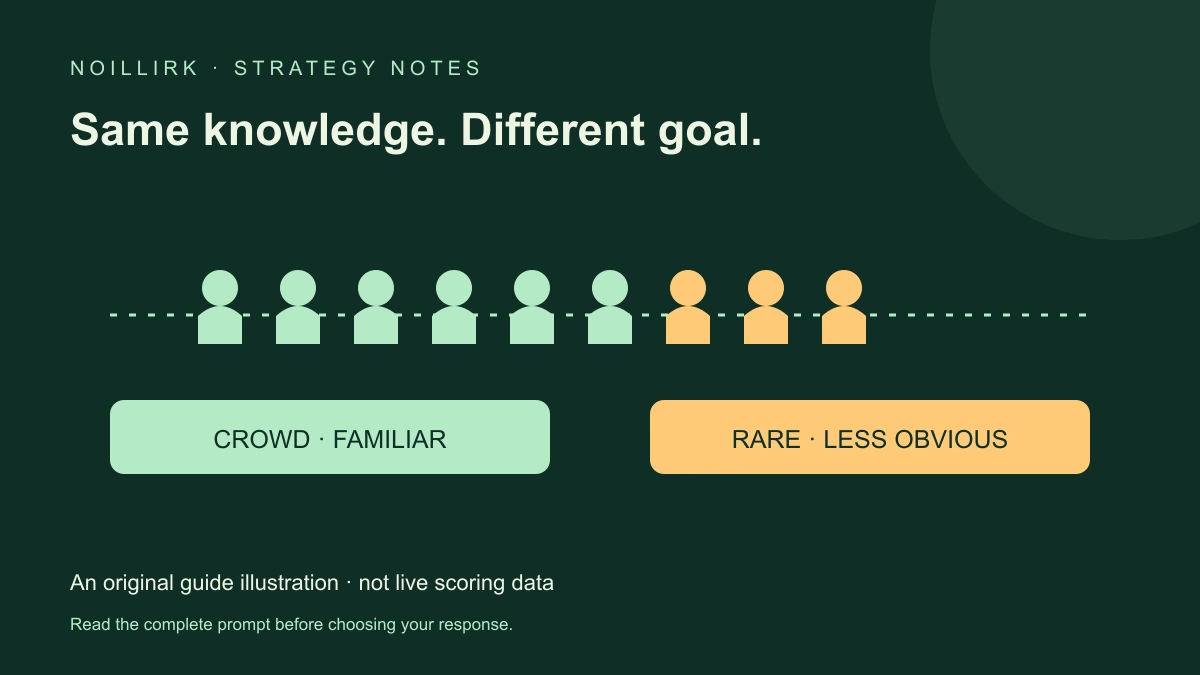
In Rare mode, remember one clearly relevant answer before looking for an alternative. Keep that first candidate available while you search the same category in a different order. You might move from a broad familiar example to another member you learned alongside it. This gives you a stopping point: if no stronger candidate comes to mind, you still have a response that you understand and can type.
Avoid turning the search for rarity into a search for obscurity at any cost. A specialised term can be a good candidate when it fits the wording and you know its meaning. It can also be a poor candidate when you only partly remember it. The useful question is whether you can commit confidently before the countdown finishes. There is no benefit in having an impressive idea that never reaches the answer field.
Try a few rounds with the same habit rather than judging the method from one result. Notice whether you usually run out of time while thinking, typing, or correcting a spelling. Those are different problems. Medical Krillion gives you another opportunity to practise after a round, so use the next attempt to improve one part of your decision rather than changing everything at once.
Choose the straightforward word in Crowd
Crowd mode changes what you do with the same vocabulary. Start with the candidate that a broad group of players might recall without specialist preparation. A short everyday term may be a stronger starting point than a narrow technical label, provided both match the question. You are thinking about likely recognition, not trying to prove that you know the longest or most advanced expression.
Your personal experience can distort that intuition. A word you see every day in a course may feel universal even when it is specific to your studies. Conversely, a familiar expression may seem too obvious precisely because it is the kind of answer Crowd encourages. Use the prompt’s wording and the feedback from actual rounds to refine your approach, while accepting that you cannot know the live popularity order beforehand.
Do not transfer a number from our demonstration into the live game. The practice tool only contrasts an assumed common choice with an assumed rare choice. It does not call the scoring service or reproduce the provider’s answer distribution. When you want to compare real attempts, compare the decisions you made and the results displayed inside the game, keeping the chosen mode in mind.
Submit a clear term and read the response
Type one candidate, then use the game’s answer control. A list of alternatives makes your intention less clear and may not be interpreted as a single response. Check spelling before submission when the clock allows it, especially for terms that differ by only a few characters. Prefer the full name when an abbreviation could have more than one meaning in the context of the question.
If the player suggests a correction, check that it still describes your intended answer. A correction is useful when it repairs a typing slip; it is less useful when it silently changes what you meant. Follow the live interface for any opportunity to amend or resubmit. This guide does not promise that every synonym, spelling variant, language or specialised expression is recognised by the provider.
Feedback is also an opportunity to check your reading. An answer can miss because it falls outside the requested group, because the term was entered unclearly, or because the accepted list does not cover it. The result alone may not tell you which explanation applies. Keep the exact prompt in mind and avoid treating a rejected word as proof that the underlying fact is false.
Give yourself time to finish the action
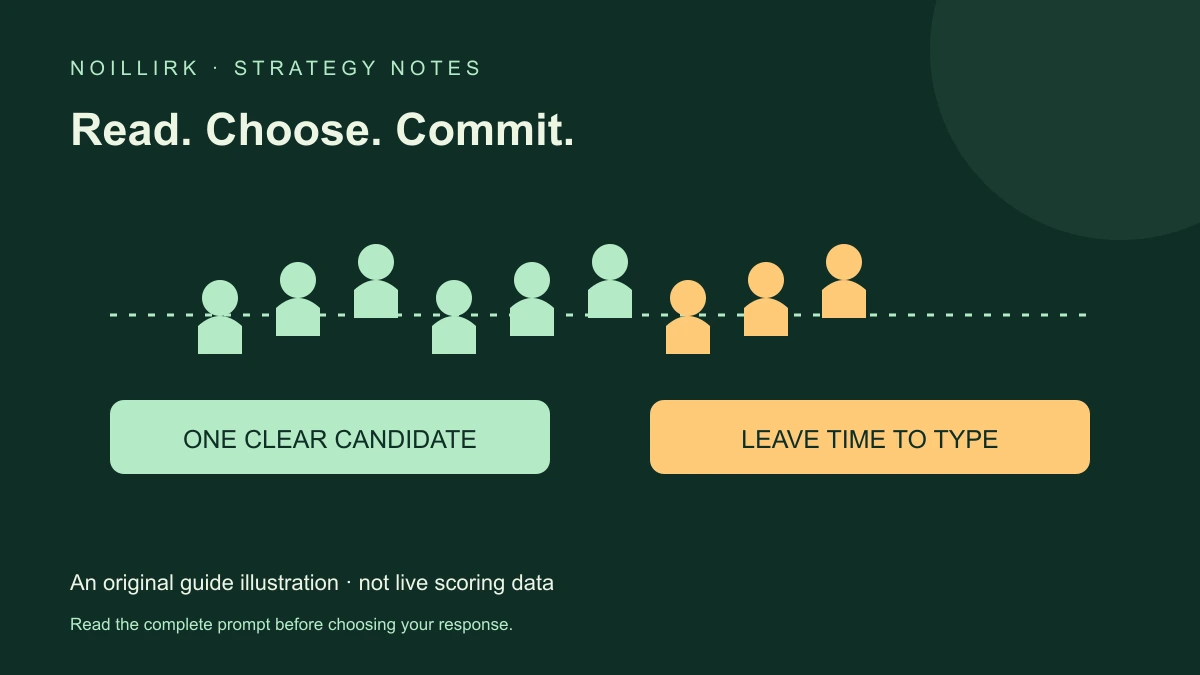
The last part of a timed response is an action, not just an idea. You need enough time to enter the text and activate submission. On a phone, opening the keyboard, correcting an accidental tap and reaching the control may take longer than expected. Make your first round a check of the interface as well as a test of memory. Find the submit control before relying on a last-second answer.
A simple personal rhythm is to read, choose and commit. Leave room between those stages rather than spending the whole countdown considering alternatives. The right balance varies with the length of your answer and your device. This is a habit you can adjust, not an additional timer enforced by the page. The game’s own countdown remains the authority for the current prompt.
Use the available Pass control when you decide to move on. Passing and submitting an uncertain answer are different decisions, and the game shows the result of the action you take. After a difficult question, begin the next one by reading its category again. Carrying frustration into the next prompt often costs more attention than the original missed answer.
Review the choice, not just the total
At the end of a Medical Krillion session, pick one moment worth reviewing. Did you choose a sensible candidate for the selected mode? Did you overlook a condition? Did you hesitate after already finding an acceptable term? A total score can describe the outcome, but these questions help you decide what to practise next. You do not need a perfect reconstruction of all ten prompts to learn from a round.
Switching modes is a useful way to revisit your decision habits. A player who routinely searches for unusual vocabulary can practise choosing the familiar option in Crowd. Someone who always commits to the first idea can try forming a second candidate in Rare. The page’s practice tool is separate from both games, so experimenting with it does not spend an in-game attempt or change a saved result.
Keep this as recreational trivia. A game score does not assess clinical competence, diagnose a condition, or replace a dependable course reference. If a question sparks curiosity, study the topic through an appropriate source after playing. Never enter patient identifiers or private case details into a public answer box; short category answers are enough for this activity.
Open the game comfortably and keep exploring
The game sits in a sixteen-by-nine frame with a direct-open link beside its controls. Desktop players can use fullscreen when supported. Phone players may find a separate tab more comfortable when the keyboard is visible. The parent page cannot control the layout inside an external game, so the direct link remains available even if the frame is blocked or the fullscreen request is rejected.
If loading stalls, use Retry once and check whether the embedded document appears. A document loading is not proof that a round has started; use the game’s own start screen to confirm readiness. Reloading can interrupt a current attempt, so avoid it while answering unless you intend to restart the player. The guide remains readable if JavaScript is unavailable, and the direct game link still works.
After a medical round, use Play More to return to common-answer, rare-answer, geography or campus games. Those experiences have their own rules and scoring, so read their start screens before comparing results. This page provides a clear doorway into one specific Medical Krillion edition, with practical help close by whenever you want to return to the strategy exercise.